 Honeyswap
 fees combine pool charges with Gnosis Chain gas for a first swap
Honeyswap fees on Gnosis Chain include a pool trading charge and separate gas payments in native xDai. Its standard Uniswap v2 pools charge 0.3% of the input entering each pool. A first ERC-20 swap may also require an approval transaction, which uses gas before the swap. Funding through a bridge or a fiat provider can add costs belonging to that service. Price impact and slippage can change the amount received without being additional pool fees. The selected route and existing spending permissions determine which costs apply.
Bottom line: A sufficient existing token allowance can avoid another approval transaction, while the pool charge and swap gas still apply.
The pool charge and its calculation base
Standard Honeyswap v2 pools on Gnosis Chain charge 0.3% of the input amount entering each pool. The rate does not scale with the account's remaining wallet balance. The fee that these liquidity pools charge forms part of their exchange calculation.
For a single pool, the fee component is
input amount × 0.003
, measured in that input token. The quote already incorporates that deduction when calculating output. Subtracting it again from the quoted output would double-count the same fee. This formula alone does not determine the amount received, because pool reserves also affect execution.
Fees along a routed trade
Routing through more than one pool applies each pool's trading charge to the input entering that hop, with the preceding output funding the next. The final quote reflects the complete path. A longer route can still return more tokens when its pools offer better liquidity. Those pool calls can fit within one router transaction, so hop count does not equal wallet transaction count. A route using another pool implementation follows that pool's fee rules.
Native xDai and the gas bill
Gas pays for transaction execution separately from the token exchange, so its amount follows computational work and the network's effective gas price. Gnosis Chain uses native xDai to pay transaction gas. The swap's input and output can be other tokens. Their balances do not supply the native currency needed for execution.
Gas units measure computation. The relationship is
actual gas charge = gas used × effective gas price
. When the price uses xDai per gas unit, the resulting charge is in xDai. A wallet estimate can change before transaction inclusion, and a fiat display adds a changing conversion rate. The final receipt records the gas used for the included transaction.
wxDai held as an ERC-20 token does not replace native xDai in the gas balance.
Approval costs before token spending
An ERC-20 allowance authorizes a specific spender to use up to an approved amount from a particular account. In the ordinary v2 router flow, insufficient allowance requires an approval before the router can take the input tokens. That approval is an on-chain transaction with its own gas charge. Native xDai input uses the router's native-currency method and does not require an ERC-20 approval for the native currency.
An existing allowance can cover another trade only for the same account, token, network, and spender. Increasing the trade amount beyond the available allowance changes that cost calculation. A larger approval expands spending permission without increasing the pool's fee rate. An allowance update can involve resetting the old allowance to zero before setting its replacement. That adds another gas charge when performed through a separate on-chain transaction.
Funding costs across networks
Funding a Gnosis wallet from Ethereum can add ETH-denominated approval and bridge gas before any xDai-denominated swap costs arise. The selected bridge can also have its own charges or limits. Those amounts belong to funding the wallet, and a swap quote need not include them.
The xDai Bridge delivers native xDai, while token-bridge routes can deliver ERC-20 balances that cannot pay native gas. A source-chain transaction and the destination credit are different events. Cross-network funding therefore needs a budget for the chosen route and the subsequent Gnosis actions.
Fiat purchase charges
Fiat purchase charges follow the payment provider's pricing, independently of the pool's swap fee and gas required for later transactions. Mt Pelerin applies different pricing to bank and card purchases, and excludes US persons from its service. A fee-free bank-purchase allowance does not make card purchases free. Bank intermediary charges can also apply to some transfers. The relevant comparison is the total fiat payment against the net crypto delivered on the selected network, including payment-method charges.
Compare first-swap funding and approval costs
For a first swap, the required gas payments follow the funding route and the account's existing allowance for the selected input token.
| Starting funds | Preparation for the swap | Gas to budget | Main cost trap |
|---|---|---|---|
| Native xDai on Gnosis | Native-input route without an ERC-20 input allowance | xDai for the swap | Committing the whole native balance leaves no gas. |
| ERC-20 on Gnosis with sufficient router allowance | Existing permission covers the input. | xDai for the swap | A token balance does not cover native gas. |
| ERC-20 on Gnosis with insufficient router allowance | Approve the input token before trading. | xDai for approval and swap | Approval gas remains spent if trading stops. |
| Tokens held on Ethereum | Supported bridge route before the Gnosis swap | ETH for Ethereum transactions; xDai for Gnosis | Funding costs can dominate a small trade. |
Consider a fixed-input ERC-20 swap on Gnosis with insufficient allowance for the selected v2 router. The selected input must fit within the approval; each pool's fee applies to the input it actually receives. Native xDai must cover approval gas and the later swap's gas.
Before approving, compare the route's output, the minimum acceptable output, and the wallet's gas estimate. Budget separately for the swap after approval. Confirm the token, spender, and approval amount before authorizing the wallet request. An unsigned, unbroadcast request offers a stop point without an on-chain charge.
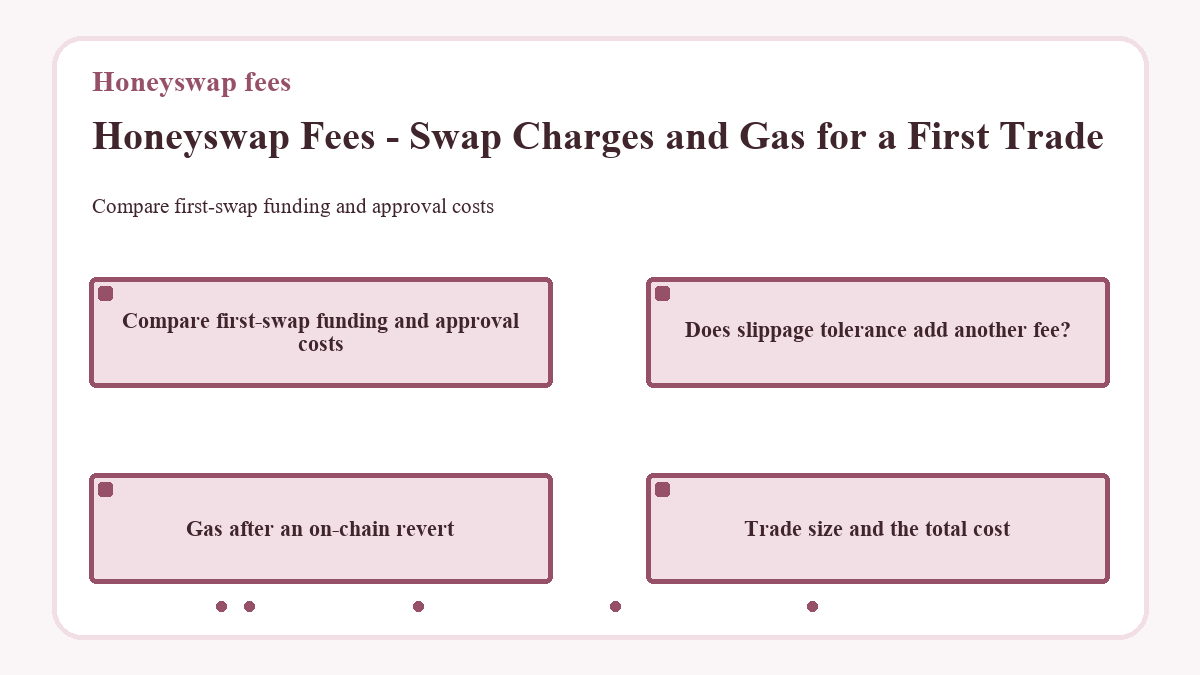
Honeyswap Fees - Swap Charges and Gas for a First Trade
- Compare first-swap funding and approval costs
- Does slippage tolerance add another fee?
- Gas after an on-chain revert
- Trade size and the total cost
A successful approval changes the allowance without exchanging the tokens. Trading can stop if the quote becomes unacceptable; the approval gas is already spent. The unused approval also remains in place. Reducing that permission through a later approval transaction uses gas too.
A transaction hash can exist while the submitted swap remains pending. A successful receipt and the recipient's resulting output-token balance distinguish a completed exchange from approval alone. The approval and swap receipts record their respective gas charges.
Does slippage tolerance add another fee?
Slippage tolerance sets an execution boundary; the router does not automatically deduct that percentage as an additional fee from the quoted output. For a fixed-input swap, the minimum output limits how few tokens the transaction may deliver. The executed amount can stay close to the quote when pool conditions permit. Raising the tolerance allows a worse accepted exchange without reducing pool charges.
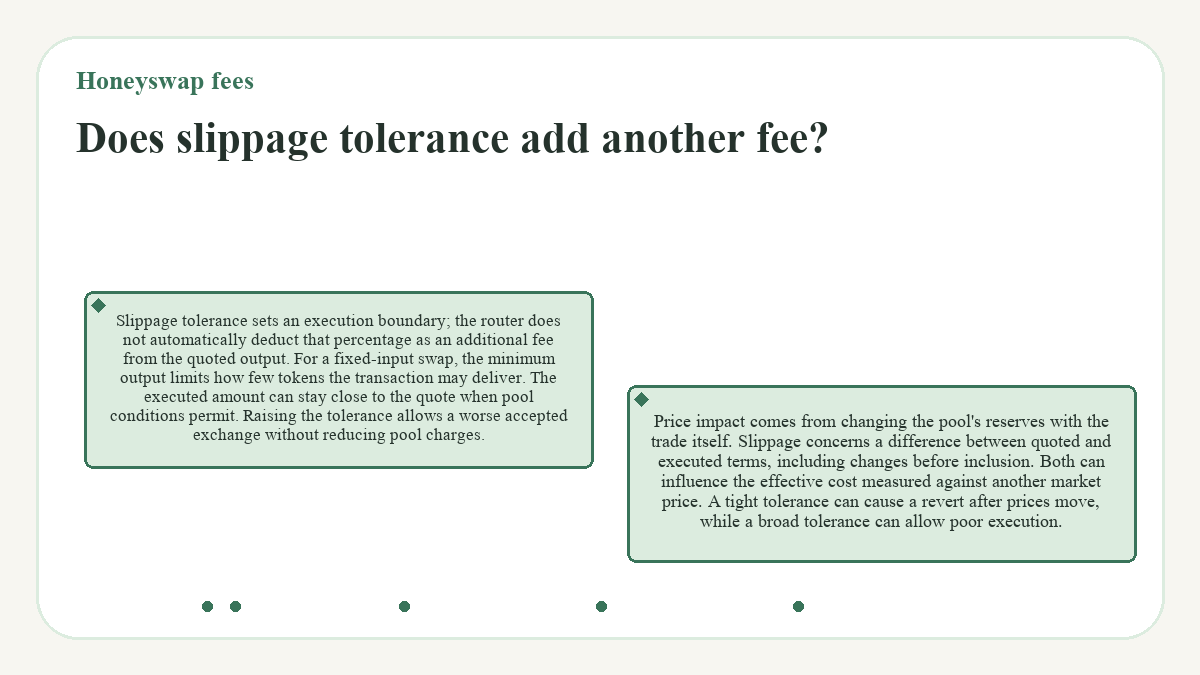
Price impact comes from changing the pool's reserves with the trade itself. Slippage concerns a difference between quoted and executed terms, including changes before inclusion. Both can influence the effective cost measured against another market price. A tight tolerance can cause a revert after prices move, while a broad tolerance can allow poor execution.
Gas after an on-chain revert
An included transaction that reverts still consumes gas for the computation it performed, even though the attempted swap's state changes roll back. The failed swap leaves no completed pool trade. An approval completed earlier remains separate, so a later revert does not return its gas.
A failed simulation has no executed on-chain transaction. It differs from a transaction included in a block with a failed status. Repeating an unchanged request can spend more gas if the underlying problem remains. An insufficient allowance, an expired deadline, or output below the submitted limit can prevent the standard router from completing a swap.
Trade size and the total cost
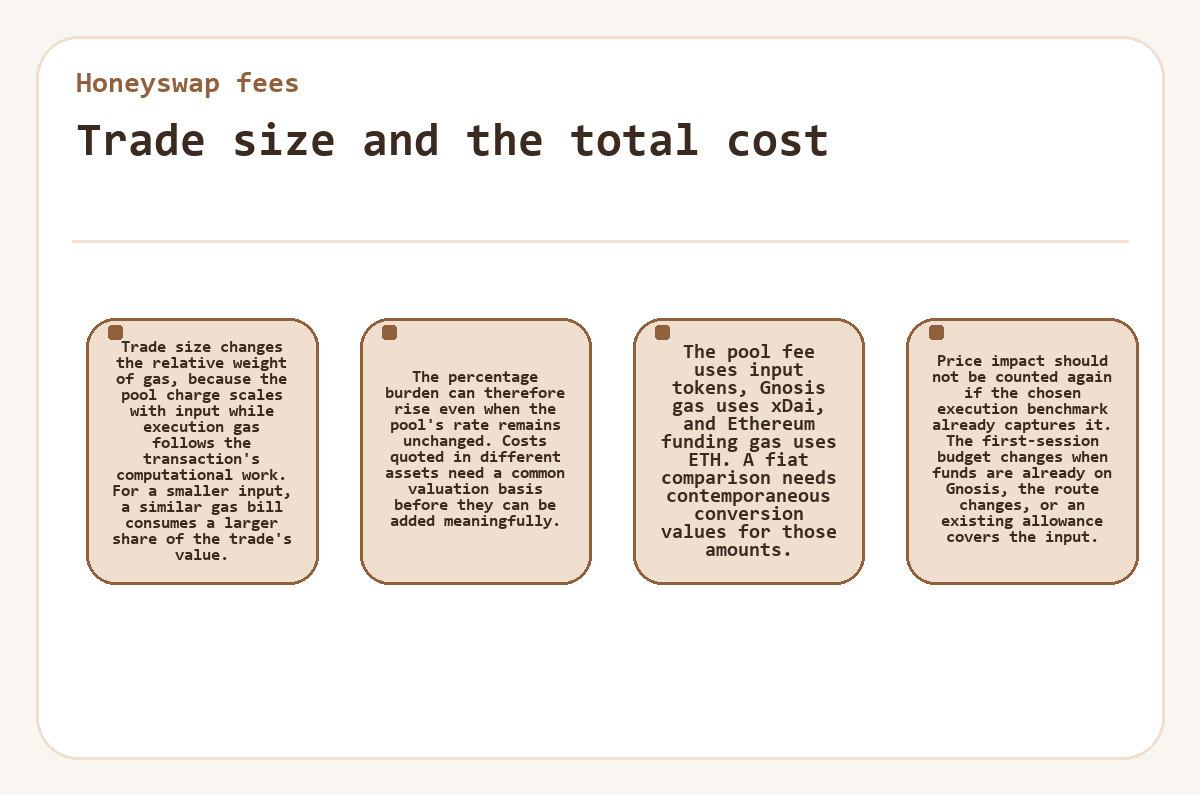
Trade size changes the relative weight of gas, because the pool charge scales with input while execution gas follows the transaction's computational work. For a smaller input, a similar gas bill consumes a larger share of the trade's value. The percentage burden can therefore rise even when the pool's rate remains unchanged.
Costs quoted in different assets need a common valuation basis before they can be added meaningfully. The pool fee uses input tokens, Gnosis gas uses xDai, and Ethereum funding gas uses ETH. A fiat comparison needs contemporaneous conversion values for those amounts. Price impact should not be counted again if the chosen execution benchmark already captures it.
The first-session budget changes when funds are already on Gnosis, the route changes, or an existing allowance covers the input.
Good to know
-
Why do some Honeyswap fee figures show 0.25% instead of 0.3%?
- The 0.25% figure describes the liquidity-provider allocation when the standard v2 protocol fee is enabled. The total pool charge remains 0.3% of traded input, with 0.05 percentage points representing the protocol share. These allocations divide one trading charge. They do not add a second charge for the trader. Disabling protocol collection changes the allocation without changing the standard pair's input fee.
-
What is the difference between a gas limit and the gas charged for a swap?
- A gas limit caps the computational units that a transaction may consume; the actual charge depends on the units consumed and their effective price. Setting a higher limit does not automatically spend the entire limit. If execution runs out of gas, the transaction reverts and consumes the full gas limit at the effective price.
-
Do I need another approval if I change the account connected to Honeyswap?
- An approval from one account does not authorize the router to spend another account's tokens. The newly connected account needs sufficient allowance for its own input token and spender on that network. Changing wallet software while keeping the same account, network, and spender does not itself create another approval requirement.
-
Can I send received tokens elsewhere without paying Honeyswap again?
- An ordinary wallet transfer of tokens received from a completed swap does not perform another Honeyswap pool trade. The transfer has its own network gas cost, and the token can impose its own transfer rules or charges. If a later action exchanges the tokens through a pool, that new trade has its own trading fee.
-
Are token transfer taxes included in the normal pool fee?
- A token's transfer charge is separate from the v2 pool's trading fee. The token contract can reduce the amount that reaches the pool or recipient. The v2 router has specific methods for fee-on-transfer tokens, and interface support depends on the method used. Ordinary swap methods can fail when the token's transfer behavior conflicts with their assumptions.
-
Does a routed swap require approvals for intermediate tokens?
- The documented v2 router flow takes the selected input token from the account and passes intermediate assets between pools. Intermediate tokens moving between those pools do not require spending allowances from your wallet. The input-token approval covers the router's withdrawal from your account. Selecting another input token or spender can introduce a different approval requirement.
-
Does paying approval gas lock in my swap quote?
- An approval records spending permission without reserving a pool price. The later swap uses the available reserves when it executes, subject to its submitted amount limits. A quote can change while the approval confirms, so the eventual trade can have different terms. Paying for approval does not purchase execution priority or a guaranteed exchange rate for the later swap.