 Honeyswap
 liquidity pools combine trading fee income with changing token exposure
Honeyswap liquidity pools give providers a share of trading fees while trades change the pool's token balances. The useful comparison is the withdrawal value, including fees, against the value of holding the same starting tokens. Relative price movement can leave a pool position behind that benchmark even when its value rises. Farming rewards add another income source under the selected farm's eligibility, emission, and withdrawal conditions.
Fee income and farm incentives
Pool fees and farming incentives contribute to a position in different ways, so a return estimate needs to identify which income it includes. Honeyswap follows the Uniswap v2 automated market maker model. Providers receive liquidity provider (LP) tokens that represent their share of a particular pool. A farm adds a separate reward arrangement to that underlying position.
Trading fees
Trading fees that accrue to LPs increase the assets backing their pool shares. Income depends on trades through that pair and the provider's share. The swap fee applies to trading volume, not the value deposited by a provider. A return estimate based on fee income needs a measurement period and a stated value for the position.
Farming rewards
Farming involves staking eligible LP tokens in a reward contract. The extra token distribution follows the selected farm's rules, separate from ordinary pool fee accrual. HNY is 1Hive's community currency; the documented xDai farming program used xComb as its local incentive token.
Eligible pool shares
A farm accepts the LP token for its designated pair and network. Liquidity in another pool does not create entitlement to that farm's emissions. The farm position still depends on the underlying liquidity, so staking the shares leaves the provider exposed to changing pool balances.
Emissions and lock terms
The original xComb plan scheduled its initial farming distribution over two years. That launch schedule is not a perpetual reward rate. New rewards depend on the farm's remaining emissions and allocation rules. The documented xComb design allows unlocked deposits and gives time-locked deposits greater reward weight, with longer locks increasing that weight. Locked LP tokens can be withdrawn once the lock expires or the farm is disabled. After expiry, another caller can downgrade a deposit's reward weight if it has not already been downgraded. Any configured downgrade fee comes from that deposit's LP tokens and is paid to the caller.
Deposit ratios and token exposure
Deposits into an existing pool should match its reserve ratio, making the pool's current price central to each contribution. The two contributions have equal market value when the pool price matches the wider market. A skewed pool price can make that balance misleading. Arbitrage trading changes the reserves as the price adjusts, potentially leaving a provider behind the value of holding the deposited tokens.
Gnosis Chain and Polygon pools require separate evaluations. Matching token symbols do not establish the same token contracts or reserve balances.
What does a displayed pool return measure?
A displayed pool return relates the income included in its calculation to a position value and measurement period. A trading-fee estimate reflects swap activity. A farm estimate may also include token incentives, whose value changes with the reward token's price. Trading volume and total pool liquidity describe different inputs: volume generates fees, while each provider receives a proportion of the LP fee income based on their share of total liquidity. A large pool can have limited trading activity, leaving relatively little fee income for the capital supplied.
An incentive-funded return estimate can fall when emissions stop, even if swap activity stays unchanged.
Price movement against the holding benchmark
Price changes affect both the market value of the underlying tokens and the quantities represented by an LP share. Arbitrage changes the reserve ratio as the pool price follows the wider market. Ignoring fee accrual, a provider consequently becomes entitled to more of the relatively cheaper token and less of the relatively more expensive one. Comparing only the original deposit value misses this change. The holding benchmark values the original token quantities at the same later prices used for the pool position.
Relative token price movement can leave a constant-product liquidity position worth less than holding the original tokens.
This difference is usually called impermanent loss or divergence loss. For a two-token constant-product position, the fee-free value difference relative to holding is
2 * sqrt(r) / (1 + r) - 1
. This assumes the pool price matches market prices at deposit and valuation. Here,
r
is the token price ratio at evaluation divided by that ratio at deposit. The calculation excludes trading fees, farm rewards, and transaction costs.
A position can gain in currency value and still trail the holding benchmark. Fees can narrow that gap, while earned rewards can add value. Both sides of the comparison need the same valuation time. The comparison subtracts costs specific to the liquidity position, including required approvals and pool entry or withdrawal. Calling the difference impermanent does not mean that it disappears on a schedule. Withdrawal fixes the quantities received at that point; later price changes affect those withdrawn holdings.
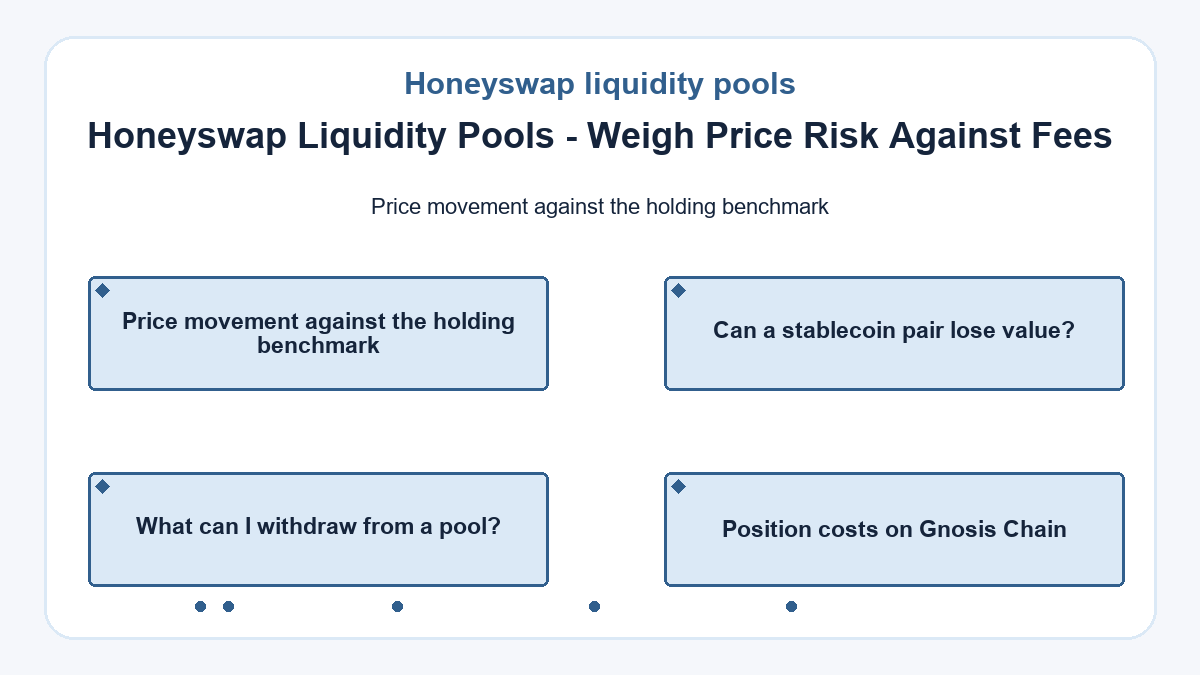
Honeyswap Liquidity Pools - Weigh Price Risk Against Fees
- Price movement against the holding benchmark
- Can a stablecoin pair lose value?
- What can I withdraw from a pool?
- Position costs on Gnosis Chain
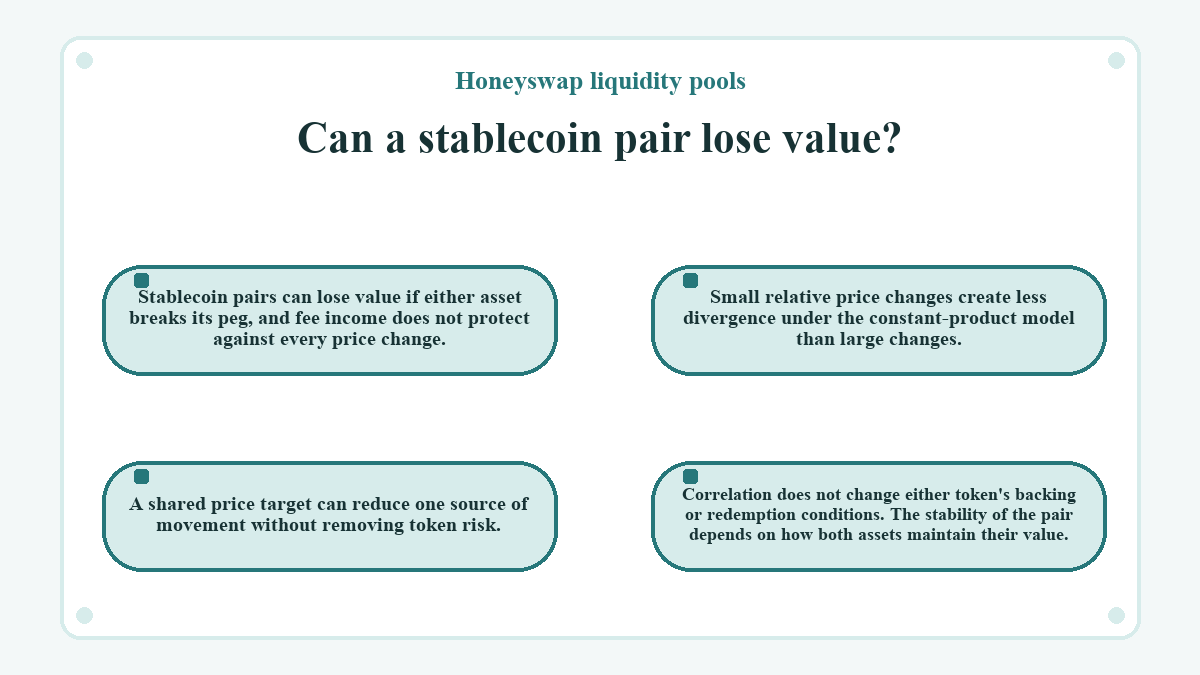
Can a stablecoin pair lose value?
Stablecoin pairs can lose value if either asset breaks its peg, and fee income does not protect against every price change. Small relative price changes create less divergence under the constant-product model than large changes. A shared price target can reduce one source of movement without removing token risk. Correlation does not change either token's backing or redemption conditions. The stability of the pair depends on how both assets maintain their value.
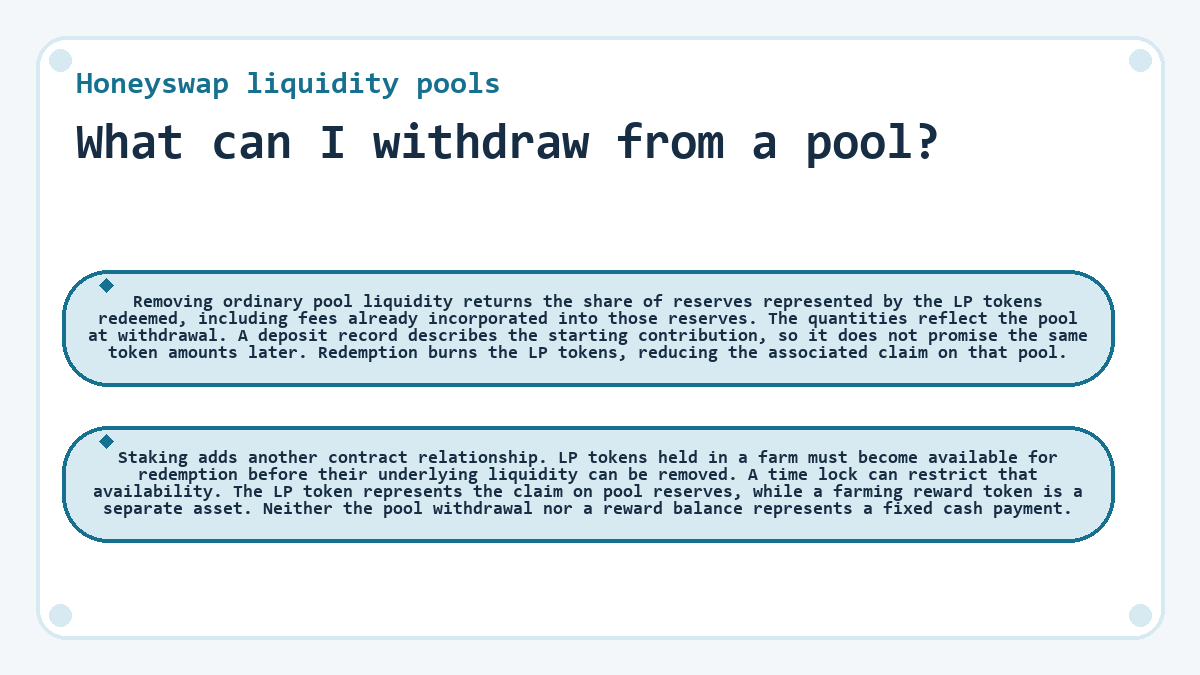
What can I withdraw from a pool?
Removing ordinary pool liquidity returns the share of reserves represented by the LP tokens redeemed, including fees already incorporated into those reserves. The quantities reflect the pool at withdrawal. A deposit record describes the starting contribution, so it does not promise the same token amounts later. Redemption burns the LP tokens, reducing the associated claim on that pool.
Staking adds another contract relationship. LP tokens held in a farm must become available for redemption before their underlying liquidity can be removed. A time lock can restrict that availability. The LP token represents the claim on pool reserves, while a farming reward token is a separate asset. Neither the pool withdrawal nor a reward balance represents a fixed cash payment.
Position costs on Gnosis Chain
Providing and removing liquidity on Gnosis Chain involves fees paid in native xDai, with extra costs when approval or a preparatory swap is required. wxDai is the ERC-20 representation used in compatible pools; it does not replace the native gas balance. Funding through a bridge adds that route's costs and conditions. The cost of a position therefore depends on its required actions and funding path. Small positions can face proportionally larger transaction costs relative to the value deposited.
A deposit limit before signing
A deposit into an existing pool exceeds its intended exposure if either required token amount crosses the limit set before signing. Consider a proposal in which the paired token amount exceeds that limit. Reducing both proposed amounts proportionally preserves the required ratio and leaves the excess funds outside the position.
- Identify the pair's token contracts and network, alongside the balances available for the deposit.
- Set an upper contribution for each token, keeping native currency available for the required network fees.
- If a required contribution exceeds either limit, reduce the unsubmitted deposit and recalculate the paired amount.
- Include required approvals and funding costs in the estimate; a smaller deposit does not necessarily reduce network charges proportionally.
- Review the revised contributions and expected LP share. Stop before signing if either amount still exceeds its limit.
The revised proposal shows smaller token contributions at the pool's required ratio. This limits the initial capital committed, without capping later price losses. Holding the original tokens preserves their quantities; pooling replaces those quantities with a share of changing reserves and fee income.
Questions worth asking
Who sets the price when a new Honeyswap pair is created?
The first liquidity provider sets a new pair's initial price through the ratio of the two tokens supplied. If that ratio differs from the wider market price, arbitrage traders can trade against the pool. The initial contribution therefore needs a meaningful price relationship; depositing two assets does not establish that their starting ratio is economically balanced.
Why can my pool ownership percentage fall after another provider deposits?
Another provider's deposit can increase the total LP-token supply, reducing the percentage represented by your unchanged LP balance. The deposit also adds underlying assets to the pool. A smaller percentage alone therefore does not demonstrate a loss in your position. Its value depends on the reserves represented by your shares and the prices of those assets.
Are LP tokens from different Honeyswap pairs interchangeable?
Each pool issues its own LP token, representing a claim on that pool's reserves. An LP token from another pair cannot redeem those reserves or substitute for the token required by a designated farm. Similar wallet labels do not establish the same claim. The relevant identity includes the LP-token contract and its network.
Does transferring my LP tokens remove liquidity from the pool?
Transferring ordinary LP tokens transfers their claim on the pool without redeeming the underlying reserves. The receiving address controls the transferred shares, while liquidity remains in the pool. Redemption requires burning LP tokens. This distinction applies to transferable shares held in a wallet; farm custody and time locks can affect whether staked shares are available to transfer.
Are farm allocation points a percentage yield on my liquidity?
Allocation points determine a pool's relative share of farm emissions in the documented xDai xComb design. They are not a percentage return on a deposit. The program divides emissions among pairs in proportion to their allocation points, subject to its referral allocation. A provider's return also depends on the deposit's share of the farm pool's total reward weight and the reward token's value.
Can farm governance unlock time-locked LP deposits?
The Admin role in the documented xDai xComb farm design can initiate a migration that withdraws xComb and unlocks all time-locked deposits. That administrative power does not give each depositor an ordinary early-exit right. The Manager has a different role: adding or removing pools and adjusting their allocation points. These permissions belong to that farm design.