 Honeyswap
 uses AMM pools to exchange tokens
Honeyswap is a decentralized exchange that lets users swap tokens and provide liquidity through automated market maker (AMM) pools. Its Gnosis Chain and Polygon deployments have separate contracts and liquidity. Trades exchange assets held in those pools, while liquidity providers receive proportional shares of the pools. A connected wallet authorizes transactions on the selected network. Honeycomb adds a related farming interface, where eligible pool shares can participate in reward programs subject to their own conditions.
The contracts behind a token swap
The Gnosis deployment follows the Uniswap v2 model, which prices trades through token reserves held in smart contracts. Each pair contains two assets. Their relative balances determine the exchange relationship, with fees included in the swap calculation. The pool enforces its reserve invariant, the mathematical constraint governing the balances after a trade. A router coordinates transfers through the pools needed for a trade. An intermediate token can connect the selected input and output through a longer path. Those pool interactions can occur within one swap transaction; each hop does not require a separate wallet confirmation.
The shared interface also supports routing through third-party liquidity pools. A trade presented through the interface therefore does not necessarily use only the exchange's own pools. The actual route determines which liquidity and pool-fee rules apply.
Which networks does Honeyswap use?
Honeyswap has deployments on Gnosis Chain and Polygon, with distinct pools and contracts on each network. Older Gnosis materials use the name xDai Chain. A wallet address can exist on both chains while holding different balances, and switching networks does not transfer those assets.
Gnosis mainnet uses chain ID 100. Gnosis Chain uses xDAI to pay transaction gas fees. Wrapped xDAI is the ERC-20 representation that token pools can hold. Native xDAI and its wrapped representation serve different purposes, so a wrapped balance alone does not provide native gas funds for a standard wallet transaction.
A Gnosis token swap from selection to settlement
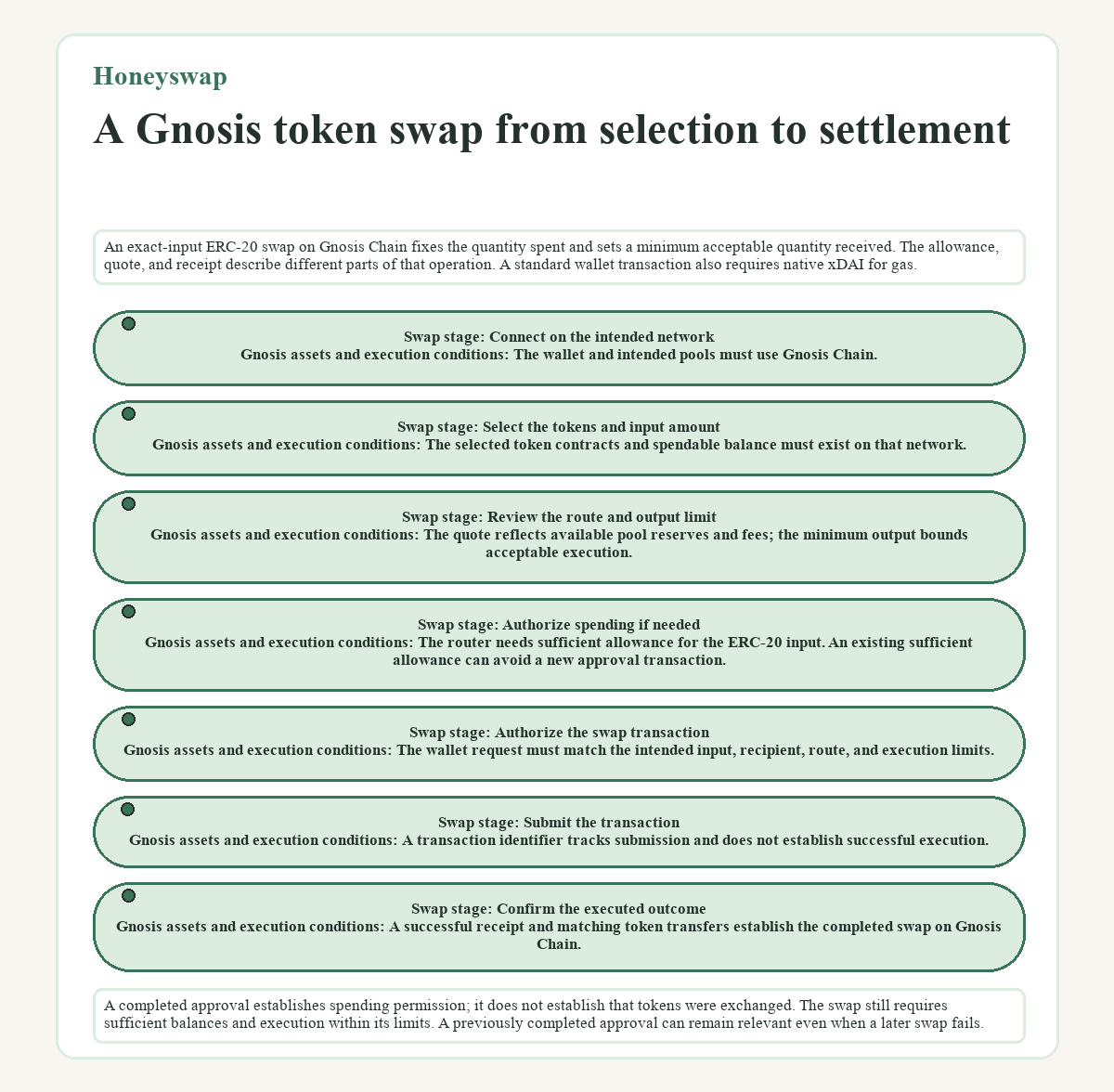
An exact-input ERC-20 swap on Gnosis Chain fixes the quantity spent and sets a minimum acceptable quantity received. The allowance, quote, and receipt describe different parts of that operation. A standard wallet transaction also requires native xDAI for gas.
| Swap stage | Gnosis assets and execution conditions |
|---|---|
| Connect on the intended network | The wallet and intended pools must use Gnosis Chain. |
| Select the tokens and input amount | The selected token contracts and spendable balance must exist on that network. |
| Review the route and output limit | The quote reflects available pool reserves and fees; the minimum output bounds acceptable execution. |
| Authorize spending if needed | The router needs sufficient allowance for the ERC-20 input. An existing sufficient allowance can avoid a new approval transaction. |
| Authorize the swap transaction | The wallet request must match the intended input, recipient, route, and execution limits. |
| Submit the transaction | A transaction identifier tracks submission and does not establish successful execution. |
| Confirm the executed outcome | A successful receipt and matching token transfers establish the completed swap on Gnosis Chain. |
A completed approval establishes spending permission; it does not establish that tokens were exchanged. The swap still requires sufficient balances and execution within its limits. A previously completed approval can remain relevant even when a later swap fails.
Price impact and slippage tolerance
Price impact comes from a trade changing pool reserves; slippage describes a difference between the quoted and executed trade. Slippage tolerance sets how much worse the execution price may be than the quote.
Pool depth and trade size
A trade that consumes a larger share of available reserves generally receives a worse average price. Low network gas costs do not prevent this effect. Increasing slippage tolerance adds no liquidity and does not improve an unfavorable pool quote.
Limits applied during execution
The Gnosis Router02 contract supports both exact-input and exact-output swaps. Each form bounds a different side of the exchange.
Fixed input
An exact-input swap specifies the amount spent and a minimum amount received. The router rejects execution when the calculated output falls below that minimum.
Fixed output
An exact-output swap specifies the quantity received and a maximum quantity spent. The router rejects execution when the required input exceeds that cap.
Liquidity deposits and pool shares
A provider contributes the underlying pair of assets to a pool and receives liquidity provider (LP) tokens. LP tokens represent a provider's proportional share of a particular liquidity pool.
Deposits into an existing v2 pool follow its reserve ratio. The required quantities therefore depend on the assets already held there. Equal token counts do not generally represent equal values, and the pool share does not promise fixed quantities at withdrawal.
Trading changes the pool's asset balances. Redeeming LP tokens returns the corresponding share of those balances, which can contain different quantities from the original deposit. Fee income forms part of the liquidity position rather than a fixed interest payment.
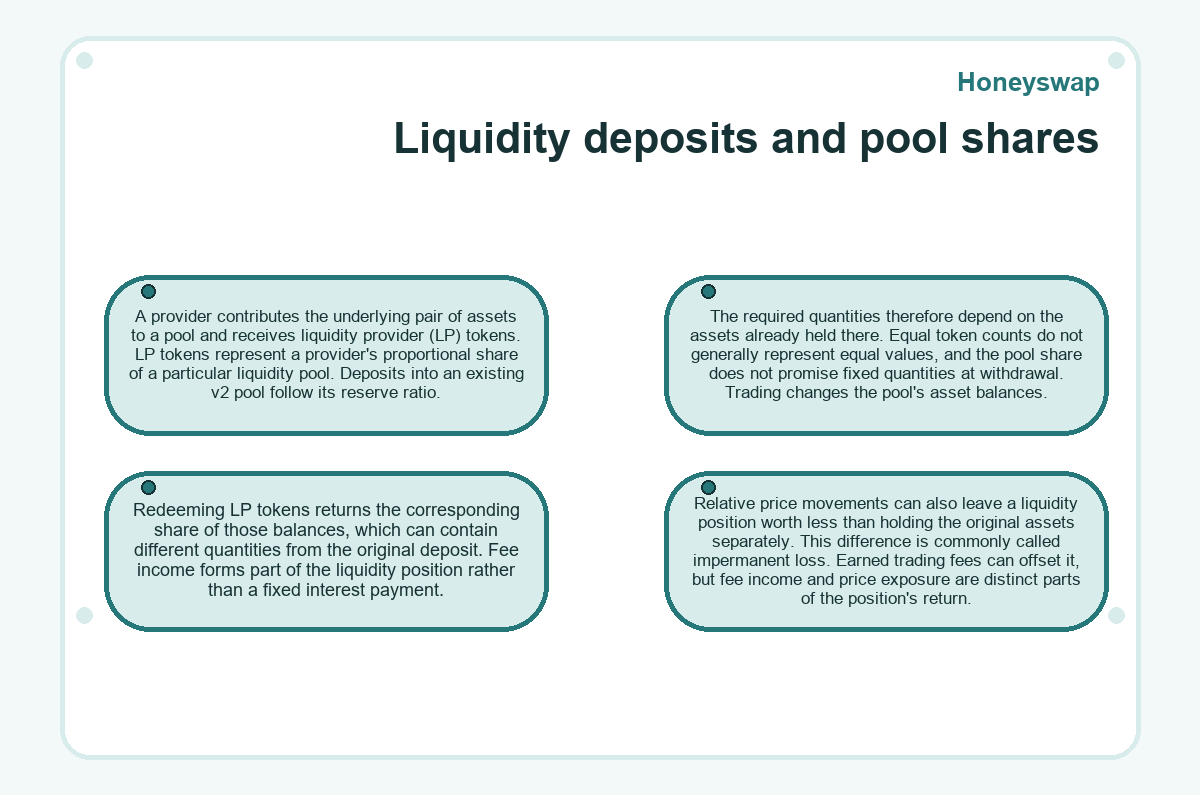
Relative price movements can also leave a liquidity position worth less than holding the original assets separately. This difference is commonly called impermanent loss. Earned trading fees can offset it, but fee income and price exposure are distinct parts of the position's return.
Does a liquidity deposit automatically earn farming rewards?
A liquidity deposit does not automatically earn farm incentives; those require a separate eligible farm deposit and an emitting reward program.
Honeycomb has provided an interface for managing pool positions and staking eligible LP tokens in Comb farms. The local incentive model uses xComb for the Gnosis deployment and pComb for Polygon. These rewards belong to the farming program associated with that chain.
Pool trading fees and farm incentives have different origins. The former arise from swaps through the pool. The latter follow the farm's reward allocation and emission schedule. The original xComb design specified a finite initial distribution period.
Farms can also add withdrawal conditions beyond the underlying pool. Under the documented HoneyFarm rules, a locked deposit normally remains locked until its unlock time. Disabling that farming contract permits withdrawals regardless of the lock. Those conditions concern the farm deposit, not every LP token.
The costs attached to each action
The Gnosis v2 pool model applies a 0.3% swap fee to the amount entering each pool. That fee base differs from the network fee paid to execute a transaction. Polygon deployments and third-party pools can use different fee rules, so the Gnosis rate is not an exchange-wide quote for every route.
Liquidity providers receive trading-fee income through their pool position; they do not receive the transaction's gas payment. Protocol-fee configuration affects the allocation of pool fees. A new on-chain token approval can incur its own gas charge, while gas usage and network conditions determine transaction costs.
Funding a wallet through a bridge or fiat purchase
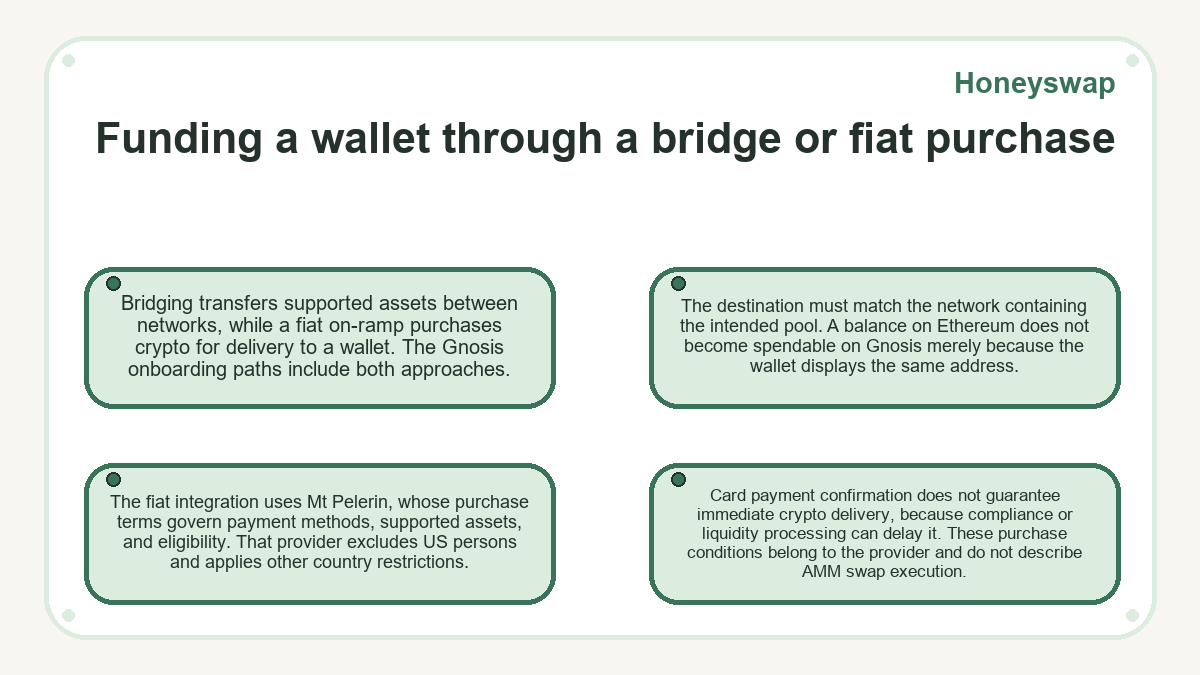
Bridging transfers supported assets between networks, while a fiat on-ramp purchases crypto for delivery to a wallet. The Gnosis onboarding paths include both approaches. The destination must match the network containing the intended pool. A balance on Ethereum does not become spendable on Gnosis merely because the wallet displays the same address.
The fiat integration uses Mt Pelerin, whose purchase terms govern payment methods, supported assets, and eligibility. That provider excludes US persons and applies other country restrictions. Card payment confirmation does not guarantee immediate crypto delivery, because compliance or liquidity processing can delay it. These purchase conditions belong to the provider and do not describe AMM swap execution.
Honey and the community's governance roles
Honey (HNY) is 1Hive's community currency and supports participation in proposals allocating resources from its common pool. The community supports exchange development and related services. The Gnosis v2 factory gives its fee administrator control over the protocol-fee recipient, without providing a pool-code upgrade mechanism. Farming governance has separate powers over reward allocation and migration. A fixed pool implementation therefore does not make every surrounding contract or reward setting immutable.
Pool analytics and the choice to hold or trade
Pool analytics describe liquidity, trading volume, and recorded trades for a selected market and network. Liquidity indicates market depth, while volume measures turnover during a period. Recorded activity describes what happened; a fresh executable quote also depends on the selected trade amount and available route.
A swap converts one asset into another. Providing liquidity creates a position whose returns combine pool fees with changes in its asset mix. Holding the underlying tokens separately avoids that pool-driven rebalancing, while leaving their market-price exposure intact.
Before you start with Honeyswap
Do I need HNY before making a swap?
HNY is not a mandatory input for swaps between other supported assets. On Gnosis Chain, a standard wallet transaction needs native xDAI for gas and the asset being exchanged. Honey's community and governance roles do not make it the network's gas currency.
Can I connect a wallet other than MetaMask?
The interface includes connection options beyond MetaMask, including WalletConnect. A compatible wallet must support the selected network and the connection method offered by the interface. Connecting establishes access to the wallet account; spending approvals and swap authorization have separate purposes.
Why is a received token missing from my wallet display?
A received token can be absent from the wallet's displayed token list even after a successful transfer. The relevant details are the selected network and that token's contract address. Adding the correct token to the display changes visibility; it does not move or recover funds.
Are wallet addresses and swap amounts public?
On-chain swaps expose participating addresses and token-transfer amounts in public transaction records. A wallet connection does not turn those records into private activity. Public records identify addresses, although an address alone does not establish the real-world identity of its owner.
What happens if a swap reaches the contract after its deadline?
The Gnosis Router02 contract rejects a swap when execution occurs after the submitted deadline. The deadline is an execution cutoff, not a promise of confirmation within that period. A transaction identifier alone does not establish that the swap executed before the cutoff.
Does one security audit cover every related contract?
A security audit covers particular contracts and code versions. The project's security documentation notes post-audit contract changes and excludes the airdrop contracts from audit coverage. That scope does not establish that every token, farm, interface, or third-party route received the same review.
Is 1Hive approval required to create a liquidity pool?
The Gnosis v2 factory allows permissionless pair creation when its contract requirements are satisfied. It rejects identical token addresses, the zero address, and an already existing pair. A pool's existence therefore does not establish that 1Hive evaluated or approved the token issuer.
Will a reverted swap still cost gas?
A swap that executes on-chain and reverts still consumes gas for the work performed. The reverted transaction's token-exchange changes do not persist, while its execution cost remains payable. Rejecting a request before broadcast is a different state and does not itself create that on-chain gas charge.