 Honeyswap
 uses wxDai to make xDai compatible with ERC-20 pools
Honeyswap uses wxDai to represent native xDai in liquidity pools on Gnosis Chain. Native xDai pays transaction fees, while wxDai supplies the token interface that pool contracts expect. These forms belong to the same network, yet occupy different balance records. This distinction explains why a wallet can hold assets suitable for pool activity while lacking native currency for gas. It also separates changing an asset's representation from exchanging it for another token or moving value between networks.
Find a section
Keep native xDai available for transaction fees when holding wxDai, because the wrapped balance does not fund ordinary gas payments.
ERC-20 compatibility beneath the pool label
An ERC-20 pool needs assets that follow a common token interface, including methods for reading balances and transferring tokens. Native xDai belongs to the chain's account system and does not implement that interface. Its wrapped form supplies the compatibility needed by contracts that handle ERC-20 assets. For a pair involving the Gnosis native currency, wxDai provides the token representation inside the pool. Other pairs can contain different ERC-20 assets; the wrapper is not a requirement for every reserve.
Honeyswap's Gnosis deployment follows the Uniswap v2 automated market maker model. A native currency label in an interface describes the user-facing asset selection; the underlying token representation remains relevant when interpreting contract balances.
Native and wrapped balances in the same wallet
A single Gnosis Chain account can have both a native xDai balance and a wxDai token balance. The wallet address identifies the owner in both cases, while the network and token contract determine which balance an application reads.
The native balance
Gnosis Chain uses native xDai to pay transaction gas fees. For an ordinary transaction paid directly by the sending account, that native balance funds execution. The wxDai balance does not increase the native xDai available for gas.
Adding wxDai to a wallet's token display does not increase its native xDai balance.
The token balance
The wxDai balance belongs to the wrapper's ERC-20 accounting. An application that requests that token balance reads the token contract for the relevant account. Native currency held at the same address does not automatically appear in that token balance.
A wxDai transfer changes the recipient's token balance. That transfer alone does not credit native currency for gas.
Gnosis parameters for the native and wrapped forms
The Gnosis mainnet identifiers distinguish the network's native currency from its ERC-20 representation.
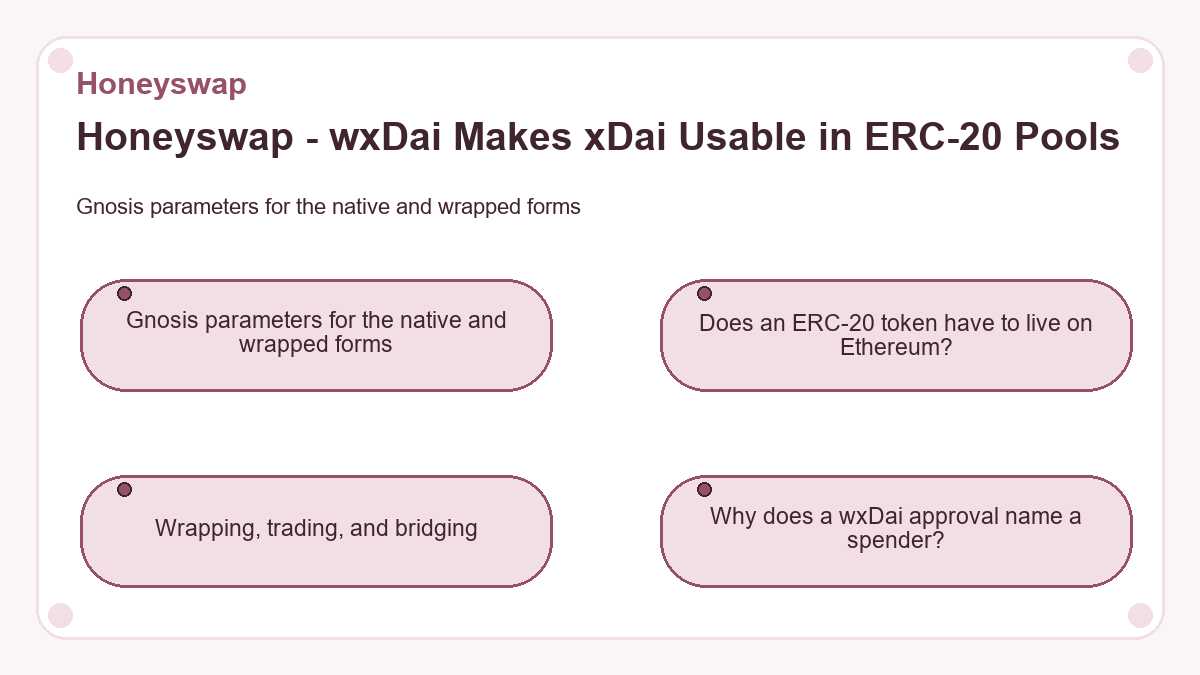
Honeyswap - wxDai Makes xDai Usable in ERC-20 Pools
- Gnosis parameters for the native and wrapped forms
- Does an ERC-20 token have to live on Ethereum?
- Wrapping, trading, and bridging
- Why does a wxDai approval name a spender?
| Parameter | Value | Scope | Meaning or limit |
|---|---|---|---|
| Chain ID | 100 | Gnosis mainnet | Identifies the network |
| Native fee currency | xDai | Gnosis transaction execution | The wrapped balance is separate |
| Native currency precision | 18 decimals | xDai accounting | Precision does not determine price |
| Wrapped native asset | wxDai | Gnosis token contracts | Provides the ERC-20 representation |
| Wrapper compatibility | ERC-20 | wxDai token interface | Does not certify application safety |
| Wrapper contract |
0xe91D153E0b41518A2Ce8Dd3D7944Fa863463a97d
|
Gnosis mainnet wxDai | The address applies on this network |
| AMM model | Uniswap v2 fork | Honeyswap on Gnosis Chain | Pool reserves govern exchange pricing |
| Token identity requires the network and contract address together; a shared symbol is insufficient. | |||
Does an ERC-20 token have to live on Ethereum?
An ERC-20 token can exist on Gnosis Chain because ERC-20 describes a token interface, not a requirement to hold that asset on Ethereum. The wxDai contract provides that interface within Gnosis Chain. Calling it ERC-20 compatible does not move its balance to another network. An address and balance must retain their network context when comparing them with assets elsewhere.
Wrapping, trading, and bridging
A different representation on Gnosis Chain
Wrapping makes the native currency usable through an ERC-20 token interface on the same chain. It does not by itself create a liquidity position or select a trading pair. The existence of the wrapper also does not establish that every application can accept both native and wrapped forms.
A reserve-priced exchange
A swap exchanges assets through liquidity held in a pool. Its exchange relationship depends on the reserves and the trade's execution conditions. Using wxDai in a pair does not remove price impact or slippage from that trade. Native currency handling and token pricing address different questions: the wrapper supplies compatibility, while the pool determines the exchange between its assets.
A transfer between networks
Bridging addresses a network boundary. The xDai bridge uses USDS as its default Ethereum-side asset to mint native xDai on Gnosis Chain. DAI deposits use the Bridge Router, which converts DAI to USDS first. Wrapping xDai concerns its representation within Gnosis Chain. Bridge processing conditions belong to the particular bridge and direction, rather than to wxDai's token standard.
Why does a wxDai approval name a spender?
A wxDai approval names a spender because ERC-20 permissions authorize a particular address to transfer tokens from an owner's balance. An ERC-20 allowance specifies how many tokens a designated spender may transfer from a particular owner's balance. That permission belongs to the token contract on the selected network. It is distinct from the token balance itself and from the gas payment that executes a transaction.
An application can use an allowance when moving tokens on the owner's behalf. The token, owner, spender, and network must match the intended operation. Approval grants permission; it does not itself establish that a swap completed or that a liquidity position exists. ERC-20 compatibility does not determine whether a requested allowance is appropriate.
The wrapper and the liquidity share
A wxDai token balance and a liquidity provider's pool share represent different holdings. The wrapped asset can form part of a pool's reserves, while liquidity tokens represent a proportional claim on that pool. A liquidity position can therefore contain exposure to wxDai without the owner's wallet holding the corresponding reserve amount directly. Pool composition and withdrawal amounts depend on the position and pool state; the wrapper's compatibility alone does not determine them.
Application support and the choice of asset form
Compatibility requires the application to support the particular asset form on Gnosis Chain. An ERC-20 integration can work with wxDai through token methods. Native currency handling requires its own implementation, including how transaction value reaches the relevant contract. A shared economic relationship does not make those interfaces interchangeable.
Native xDai supports ordinary gas payments. wxDai supports integrations that expect its ERC-20 contract. The intended operation determines which balance is relevant.
Helpful answers about Honeyswap
-
Does wrapping xDai enroll it in a savings or reward program?
- Wrapping xDai changes its representation without itself creating a savings or liquidity reward position. Pool fees relate to providing liquidity, and farming incentives involve a separate program with its own conditions. Holding the wrapped token supplies ERC-20 compatibility; that property does not establish an interest rate.
-
Is a direct wxDai transfer subject to swap slippage?
- A direct wxDai transfer does not use an AMM exchange quote. Slippage concerns the difference between a quoted exchange and its execution, whereas a token transfer moves the specified asset between addresses. A swap involving wxDai still depends on pool reserves and its execution limits.
-
Does disconnecting a wallet cancel its wxDai allowance?
- Disconnecting a wallet from a website does not change an allowance stored in the token contract. The website connection and the on-chain spending permission are separate. Changing that permission requires an appropriate on-chain action; closing the interface does not revoke the spender's existing authorization.
-
Will using wxDai hide my token transfers?
- Using wxDai does not make its ERC-20 transfers private. ERC-20 transfer events identify the sending address, receiving address, and token amount in public blockchain records. A wallet address is different from a person's name, but the wrapped representation does not conceal those transfer details.
-
What do xDai's 18 decimal places mean for a wallet balance?
- The 18 decimal places describe the precision used to represent xDai amounts. Decimal precision determines how an integer accounting amount becomes a readable balance. It does not establish a dollar price, a yield, or an exchange rate against another token, and a wallet may display fewer decimal places.
-
Can I send wxDai to a service that requests native xDai?
- A native xDai deposit requirement does not establish that a service accepts wxDai. A wxDai transfer credits an ERC-20 balance, so the receiving service must support that token on Gnosis Chain. Using an address with the same format does not convert the transfer into a native currency payment.